Image

Image
Showing posts with label Egypt. Show all posts

March 4, 2011

Potsherd

The ancient town of Meroë, in Sudan, had already been excavated for about thirty-five years when the University of California African Expedition was leaving Egypt and moving south through Sudan. In his 1949 chronicles, the anthropologist Henry Field wrote:
     during a brief stop at Meroë, we took some photographs and collected a series of sherds.
This fragment of a large decorated vessel is one of the sixty fragments that were collected from the surface that day. In the footnotes, Field specified that this town was:
     not to be confused with Merowe (Napata) on the bend of the Nile. [John] Garstang, who excavated here from 1909 to 1914, found the Temple of Amun, the baths and Temple of Aspert (circa 590 B.C.) and the Temple of the Sun mentioned by Herodotus. Reisner (1920-1925) excavated a cemetery of brick pyramids used about 355-300 B.C.
The origin of both towns is with the Twenty-fifth dynasty of Egypt whose pharaohs were Nubians and briefly ruled in the 8th century B.C. They left a trail of inscriptions where they portray themselves as the custodians of an "Egyptian" identity that they felt was being diluted by Asian influence. Their military enterprises against the Assyrians, however, failed to gain them a decisive victory and they were eventually defeated and driven back to their homeland. In the following centuries the capital - Napata - lost most of its appeal. Without the labor and skills of Egyptian artisans, the city infrastructures and bureaucracy started to crumble and the common people went quietly back to the previous way of life. The final demise of Napata as a power center is still matter of research.
Reisner's opinion was that the Meroitic culture was merely a continuation of the Napatan, originating after the transfer of the capital to Meroë and still unable to stop the decline of its past fortune. He dated the rise of the Meroitic kingdom to 308 B.C. but he also believed that  Nubian kings would return to be buried at Napata, which remained their sacred cradle for many decades afterward.
His interpretation and chronology had been variously challenged by other historians. One line of criticism came from the reading of Herodotus whose Histories have no mention of Napata while he wrote about "the great city of Meroë which is said to be the capital of the other Ethiopians (II, 29)". Since Herodotus was writing around 450 B.C. it made more sense to them to favor the establishment of Meroë as the royal palace and burial ground at 538 B.C.

One potsherd can tell a very long story.


Hearst Museum # 5-1004
Potsherd
Africa; Sudan; Meroë
Collected by UC African Expedition 1947-1948

John Garstang's field notes and collections are curated at the Garstang Museum of Archaeology, University of Liverpool. 

July 26, 2010

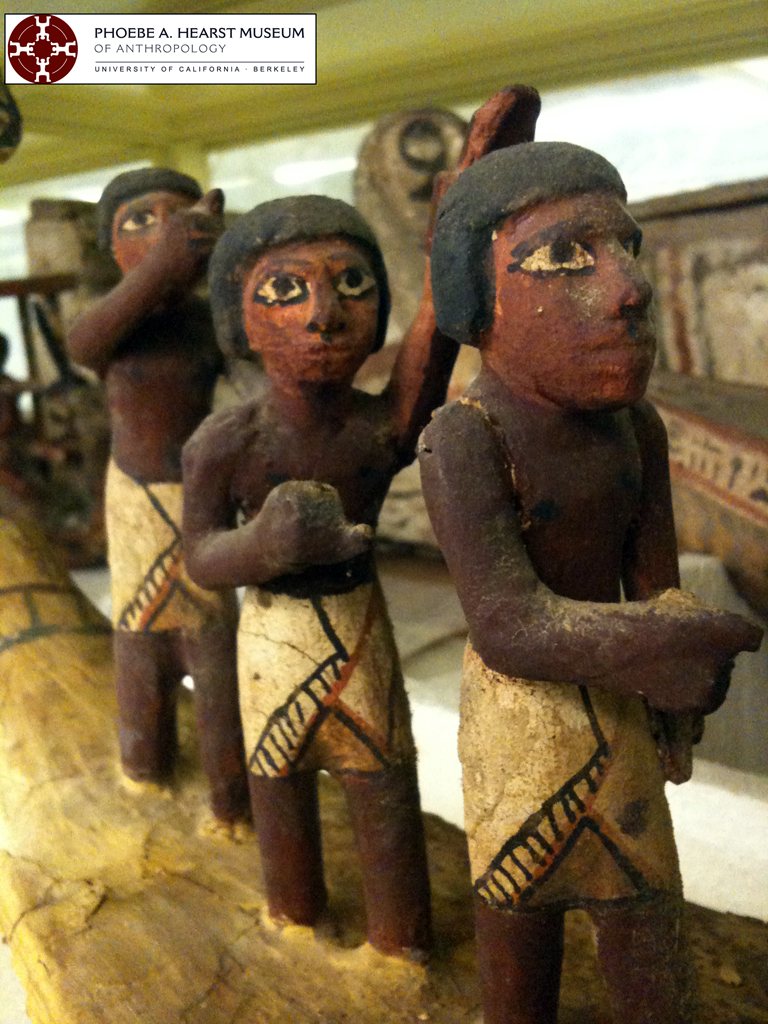
Fake boat

To complement the Egyptian collections acquired by George Reisner under the patronage of Phoebe Hearst, the museum accessioned a number of objects from other sources and donors throughout its history. Some of them later turned out to be modern or contemporary reproductions of archaeological pieces. In other words: fakes.
Fakes and forgeries are rather common in museum collections and PAHMA is no exception. It should be specified that in many cases fake objects were willingly accessioned despite or indeed because of their nature. Known forgeries curated in Berkeley include ancient Roman coins, Mexican figurines, Egyptian scarabs, Chinese pottery and even a shrunken "head" from Ecuador made with animal skin and hair.
In 1992, a selection of such objects was featured in a public exhibit entitled Too Good To Be True. The following text is what visitors could read almost twenty years ago on the exhibit label for today's object.

Egyptian funerary boats were traditionally used in the funerary voyages to and from the sanctuary of Osiris at Abydos. To be without a boat for this crossing meant that the spirit might be barred from immortality. This particular model was made in 1935 A.D. and purchased in Egypt by Mrs. Alma Spreckles while on a buying trip for the California Palace of the Legion of Honor in San Francisco. Model boats are now often crudely made from genuine pieces of ancient wood or, more commonly, "antiqued" by immersing the wood in camel urine, a process which greatly enhances the boat's aura and aroma.

According to the Smithsonian Institution in the last decade more than 60,000 fakes were sequestered by the Italian police before they could enter the market. Can anyone calculate how much urine would be needed?
The featured boat is ca. 62 cm long while the figures are ca. 12-15 cm tall.


Hearst Museum # 5-14112
Funerary boat model (detail)
Egypt; unspecified (purchased in Egypt)
Collected by Alma Spreckles, 1935

March 5, 2010

Knife

This flint knife was donated to the museum by Heywood W. Seton-Karr, a British Army lieutenant who made his earlier archaeological discoveries while he was stationed in Egypt and, later, as a private consultant. In 1895 he presented his finds to the British Anthropological Institute and in1898 his enterprises were featured in the New York Times.

Not a trained archaeologist, Mr. Seton-Karr benefited from having access to Sir. John Evans type collection of Paleolithic implements. His first sizable collections thus included mostly Paleolithic hand axes that he recovered during his hunting trips in East Africa.
In a letter to the President of the University of California dated to 1925, he listed “twenty-nine expeditions to India, thirteen in Somaliland, nine in the Fayum region, and several in the Eastern and Western Deserts of Egypt”. Mr. Seton-Karr donated portions of his collection to a large number of museums around the world. The stone tools in storage at the PAHMA came via the Smithsonian Institution and the Peabody Museum.

In 1905 he published his findings in the Fayum region in a book of  drawings whose reviewer in the MAN journal praised for its usefulness for researcher but also complained that it was hard to obtain a copy.

Mr. Heywood Seton-Karr last donation came to the museum in 1931 but because the donor demanded that the specimen would be on permanent exhibit it was initially rejected. Once he agreed to remove the condition the gift was accepted.
A selection of his stone tools from Egypt and Somalia was exhibited for the first time in Berkeley in the Fall of 1940.


Hearst Museum # 5-557
Flint knife
Fayum, Egypt
Collected and donated by H.W. Seton-Karr