Yesterday, one of our volunteers was very excited to learn that the PAHMA curates some of the oldest stone tools ever fabricated. Coincidentally, two of them were briefly featured two years ago for the University Cal-Day event. Before presenting them here I would like to sincerely thank our many volunteers without whose work many projects at the museum would simply not happen.
This chopper from the Olduvai Gorge in Tanzania was dated to 1.8 million years ago. It was likely made by Homo abilis that is considered to be the first tool-maker. The Oldowan tradition will continue until 800.000 years ago overlapping in places with the later and more elaborate Acheulean tools.
Hearst Museum 5-1997
Chopper or bashing stone, quartz
Tanzania, Olduvai Gorge, Site FLK I
Collected by J. Desmond Clark, September 1960.
The hand-axe, also from the gorge, was dated to 1 million years ago and attributed to the Early Acheulean. Similar hand-axes were originally crafted by Homo ergaster/erectus as early as 1.5 million years ago. A few millennia later they accompanied him in his early forays to the Middle East and Europe where they represent the oldest evidence of human presence outside of Africa.
Hearst Museum 5-7826
Hand axe, nephelenite lava
Tanzania, Olduvai Gorge, Site KRK-III or IV, surface
Collected by Richard L. Hay, 1962 or 1964.
Below you can read the short text that accompanied the objects in the gallery with a philosophical commentary.
Stories about archaeology, people and places from the collections at the Hearst Museum
Image
Showing posts with label Acheulean. Show all posts
February 26, 2011
February 4, 2011
Chopper
The Department of Anthropology at University of California, Berkeley was established in 1901. In the words of Frederick W. Putnam the department and the museum were "necessary" to properly organize several archaeological and ethnological expeditions maintained on behalf of the University by Mrs. Phoebe A. Hearst*.
Phoebe Hearst didn't seem particularly enthusiastic about European prehistory although she had few objects - such as this scraper from Sweden - in her personal collection. As patron of the museum she financially supported Alfred Emerson in his collecting trips to Europe and around the Mediterranean. The turn of the last century witnessed a wealth of prehistoric research in the Old World but he largely focused on classical archaeology.
Between the world wars, a few single objects and small lithic assemblages from important paleolithic sites - mostly in France - were acquired. By the late 1960's these accessions had ceased and only few exchanges with other institutions took place. Old World archaeology at UC Berkeley was then mostly dedicated to Africa while European prehistory remained in the background. By the time professors Ruth Tringham and Meg Conkey came to the department in 1978 and 1987 respectively archaeology had greatly changed its modus operandi since the days of Putnam and Emerson. Large shipments of artifacts across the globe were no longer the norm as maintaining the relationship between objects and their original context was more highly valued and European governments began to restrict the trade in archaeological objects.
Laws on the export of cultural heritage are now very strict worldwide. Although, in the course of my own archaeological research, the Croatian government always granted me permission to borrow archaeological materials to study, traveling through customs was often challenging.
When compared to holdings from other geographic regions, today PAHMA curates a smaller collection of prehistoric artifacts of European provenience. It contains type tools of most cultures and traditions with the notable exception of the neolithic. Featured today is the biggest (and also one of the oldest) object in the European prehistoric collection. The chopper was collected in the Tagus Valley, in Portugal, by J. Desmond Clark; it measures 14 x 23.5 cm (5'5" x 9'2" in). Acheulean tools appeared in Europe around half million years ago.
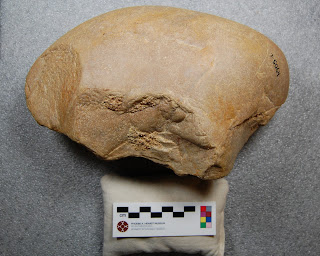
Hearst Museum 7-5064
Early Acheulean cobble chopper
Europe, Portugal, Barreiras do Vale do Forno
Collected by J. Desmond Clark, September, 1964
...............................................................................
*Dr. Ira Jacknis, the museum anthropologist, wrote a thorough history on the origins of the museum and the roles of its early constituents. For those who'd like to read it, please follow this link.

Phoebe Hearst didn't seem particularly enthusiastic about European prehistory although she had few objects - such as this scraper from Sweden - in her personal collection. As patron of the museum she financially supported Alfred Emerson in his collecting trips to Europe and around the Mediterranean. The turn of the last century witnessed a wealth of prehistoric research in the Old World but he largely focused on classical archaeology.
Between the world wars, a few single objects and small lithic assemblages from important paleolithic sites - mostly in France - were acquired. By the late 1960's these accessions had ceased and only few exchanges with other institutions took place. Old World archaeology at UC Berkeley was then mostly dedicated to Africa while European prehistory remained in the background. By the time professors Ruth Tringham and Meg Conkey came to the department in 1978 and 1987 respectively archaeology had greatly changed its modus operandi since the days of Putnam and Emerson. Large shipments of artifacts across the globe were no longer the norm as maintaining the relationship between objects and their original context was more highly valued and European governments began to restrict the trade in archaeological objects.
Laws on the export of cultural heritage are now very strict worldwide. Although, in the course of my own archaeological research, the Croatian government always granted me permission to borrow archaeological materials to study, traveling through customs was often challenging.
When compared to holdings from other geographic regions, today PAHMA curates a smaller collection of prehistoric artifacts of European provenience. It contains type tools of most cultures and traditions with the notable exception of the neolithic. Featured today is the biggest (and also one of the oldest) object in the European prehistoric collection. The chopper was collected in the Tagus Valley, in Portugal, by J. Desmond Clark; it measures 14 x 23.5 cm (5'5" x 9'2" in). Acheulean tools appeared in Europe around half million years ago.
Hearst Museum 7-5064
Early Acheulean cobble chopper
Europe, Portugal, Barreiras do Vale do Forno
Collected by J. Desmond Clark, September, 1964
...............................................................................
*Dr. Ira Jacknis, the museum anthropologist, wrote a thorough history on the origins of the museum and the roles of its early constituents. For those who'd like to read it, please follow this link.
April 10, 2010
Core
After serving as curator and director of the National Museum of Zambia (1938-1961), J. Desmond Clark came to UC Berkeley in 1961 and for almost thirty years he trained students in anthropology and Old World prehistory.
Prof. Clark was instrumental for increasing the size and scientific value of the Old World prehistoric collections at the PAHMA with assemblages from his research in Africa and Asia and by promoting active programs of exchange with museums in Africa and Europe intended to complement the preexisting collections.
The museum houses assemblages from a few archaeological sites excavated by his students mainly in the early 1970's. Some of these collections were never fully studied and published by their original investigators. This quartzite core is part of a sizable assemblage from an excavation in the Democratic Republic of the Congo between 1971 and 1973. The stone tools were deposited at the museum a few years later with little information as to their provenience, collection methods or field notes. J. Desmond Clark recalls this project in his memoirs*:
Various sites in the Congo or Rwanda have a longish sequence from the late Acheulean through the Middle Stone Age. One site in the Katanga Province, in Zaire, it was dug by a delightful old French priest, Pere Anciaux de Faveaux, who had found this site and reported on it in the Third Pan-African Congress [...]. He found a very nice Acheulean site at the Pupa River near Katentania on the Biano River, and a student of mine, Carney Schokkenbroek [...] did a very nice excavation of the Acheulean and overlying Lupenbaum following on from what Anciaux did, and she was out there for probably two years, I think, working on those collections, doing the excavation, et cetera, with Anciaux. But she never wrote it up. We were hoping she would write it up, but she seems to have disappeared now.
Perhaps she had disappeared but the stone tools are still in Berkeley.
Hearst Museum # uncatalogued
* J. Desmond Clark, "An Archaeologist at Work in African Prehistory and Early Human Studies: Teamwork and Insight," an oral history conducted in 2000-2001 by Timothy Troy, Regional Oral History Office, The Bancroft Library, University of California, Berkeley, 2002.
Prof. Clark was instrumental for increasing the size and scientific value of the Old World prehistoric collections at the PAHMA with assemblages from his research in Africa and Asia and by promoting active programs of exchange with museums in Africa and Europe intended to complement the preexisting collections.
The museum houses assemblages from a few archaeological sites excavated by his students mainly in the early 1970's. Some of these collections were never fully studied and published by their original investigators. This quartzite core is part of a sizable assemblage from an excavation in the Democratic Republic of the Congo between 1971 and 1973. The stone tools were deposited at the museum a few years later with little information as to their provenience, collection methods or field notes. J. Desmond Clark recalls this project in his memoirs*:
Various sites in the Congo or Rwanda have a longish sequence from the late Acheulean through the Middle Stone Age. One site in the Katanga Province, in Zaire, it was dug by a delightful old French priest, Pere Anciaux de Faveaux, who had found this site and reported on it in the Third Pan-African Congress [...]. He found a very nice Acheulean site at the Pupa River near Katentania on the Biano River, and a student of mine, Carney Schokkenbroek [...] did a very nice excavation of the Acheulean and overlying Lupenbaum following on from what Anciaux did, and she was out there for probably two years, I think, working on those collections, doing the excavation, et cetera, with Anciaux. But she never wrote it up. We were hoping she would write it up, but she seems to have disappeared now.
Perhaps she had disappeared but the stone tools are still in Berkeley.
Hearst Museum # uncatalogued
Core
Dem. Rep. of the Congo; Katanga Prov.; Pupa River near Katentania
Collected by Carney Schokkenbroek, 1973
* J. Desmond Clark, "An Archaeologist at Work in African Prehistory and Early Human Studies: Teamwork and Insight," an oral history conducted in 2000-2001 by Timothy Troy, Regional Oral History Office, The Bancroft Library, University of California, Berkeley, 2002.
Subscribe to:
Posts (Atom)

