Yesterday, one of our volunteers was very excited to learn that the PAHMA curates some of the oldest stone tools ever fabricated. Coincidentally, two of them were briefly featured two years ago for the University Cal-Day event. Before presenting them here I would like to sincerely thank our many volunteers without whose work many projects at the museum would simply not happen.
This chopper from the Olduvai Gorge in Tanzania was dated to 1.8 million years ago. It was likely made by Homo abilis that is considered to be the first tool-maker. The Oldowan tradition will continue until 800.000 years ago overlapping in places with the later and more elaborate Acheulean tools.
Hearst Museum 5-1997
Chopper or bashing stone, quartz
Tanzania, Olduvai Gorge, Site FLK I
Collected by J. Desmond Clark, September 1960.
The hand-axe, also from the gorge, was dated to 1 million years ago and attributed to the Early Acheulean. Similar hand-axes were originally crafted by Homo ergaster/erectus as early as 1.5 million years ago. A few millennia later they accompanied him in his early forays to the Middle East and Europe where they represent the oldest evidence of human presence outside of Africa.
Hearst Museum 5-7826
Hand axe, nephelenite lava
Tanzania, Olduvai Gorge, Site KRK-III or IV, surface
Collected by Richard L. Hay, 1962 or 1964.
Below you can read the short text that accompanied the objects in the gallery with a philosophical commentary.
Stories about archaeology, people and places from the collections at the Hearst Museum
Image
February 26, 2011
February 4, 2011
Chopper
The Department of Anthropology at University of California, Berkeley was established in 1901. In the words of Frederick W. Putnam the department and the museum were "necessary" to properly organize several archaeological and ethnological expeditions maintained on behalf of the University by Mrs. Phoebe A. Hearst*.
Phoebe Hearst didn't seem particularly enthusiastic about European prehistory although she had few objects - such as this scraper from Sweden - in her personal collection. As patron of the museum she financially supported Alfred Emerson in his collecting trips to Europe and around the Mediterranean. The turn of the last century witnessed a wealth of prehistoric research in the Old World but he largely focused on classical archaeology.
Between the world wars, a few single objects and small lithic assemblages from important paleolithic sites - mostly in France - were acquired. By the late 1960's these accessions had ceased and only few exchanges with other institutions took place. Old World archaeology at UC Berkeley was then mostly dedicated to Africa while European prehistory remained in the background. By the time professors Ruth Tringham and Meg Conkey came to the department in 1978 and 1987 respectively archaeology had greatly changed its modus operandi since the days of Putnam and Emerson. Large shipments of artifacts across the globe were no longer the norm as maintaining the relationship between objects and their original context was more highly valued and European governments began to restrict the trade in archaeological objects.
Laws on the export of cultural heritage are now very strict worldwide. Although, in the course of my own archaeological research, the Croatian government always granted me permission to borrow archaeological materials to study, traveling through customs was often challenging.
When compared to holdings from other geographic regions, today PAHMA curates a smaller collection of prehistoric artifacts of European provenience. It contains type tools of most cultures and traditions with the notable exception of the neolithic. Featured today is the biggest (and also one of the oldest) object in the European prehistoric collection. The chopper was collected in the Tagus Valley, in Portugal, by J. Desmond Clark; it measures 14 x 23.5 cm (5'5" x 9'2" in). Acheulean tools appeared in Europe around half million years ago.

Hearst Museum 7-5064
Early Acheulean cobble chopper
Europe, Portugal, Barreiras do Vale do Forno
Collected by J. Desmond Clark, September, 1964
...............................................................................
*Dr. Ira Jacknis, the museum anthropologist, wrote a thorough history on the origins of the museum and the roles of its early constituents. For those who'd like to read it, please follow this link.
Phoebe Hearst didn't seem particularly enthusiastic about European prehistory although she had few objects - such as this scraper from Sweden - in her personal collection. As patron of the museum she financially supported Alfred Emerson in his collecting trips to Europe and around the Mediterranean. The turn of the last century witnessed a wealth of prehistoric research in the Old World but he largely focused on classical archaeology.
Between the world wars, a few single objects and small lithic assemblages from important paleolithic sites - mostly in France - were acquired. By the late 1960's these accessions had ceased and only few exchanges with other institutions took place. Old World archaeology at UC Berkeley was then mostly dedicated to Africa while European prehistory remained in the background. By the time professors Ruth Tringham and Meg Conkey came to the department in 1978 and 1987 respectively archaeology had greatly changed its modus operandi since the days of Putnam and Emerson. Large shipments of artifacts across the globe were no longer the norm as maintaining the relationship between objects and their original context was more highly valued and European governments began to restrict the trade in archaeological objects.
Laws on the export of cultural heritage are now very strict worldwide. Although, in the course of my own archaeological research, the Croatian government always granted me permission to borrow archaeological materials to study, traveling through customs was often challenging.
When compared to holdings from other geographic regions, today PAHMA curates a smaller collection of prehistoric artifacts of European provenience. It contains type tools of most cultures and traditions with the notable exception of the neolithic. Featured today is the biggest (and also one of the oldest) object in the European prehistoric collection. The chopper was collected in the Tagus Valley, in Portugal, by J. Desmond Clark; it measures 14 x 23.5 cm (5'5" x 9'2" in). Acheulean tools appeared in Europe around half million years ago.
Hearst Museum 7-5064
Early Acheulean cobble chopper
Europe, Portugal, Barreiras do Vale do Forno
Collected by J. Desmond Clark, September, 1964
...............................................................................
*Dr. Ira Jacknis, the museum anthropologist, wrote a thorough history on the origins of the museum and the roles of its early constituents. For those who'd like to read it, please follow this link.
December 18, 2010
Palette
Frederick C. Gamst collected this small grinding stone from the surface of the site at Koken, Eritrea, in 1964. His research in the horn of Africa in the 1960's led him to argue that civilization and urban centers are not necessarily related or codependent and that in preliterate western Africa urbanism existed without civilization.
Gamst collection included two other objects from Koken; all them dated back to the Neolithic. The catalogue card includes a bibliographic reference for a 1954 paper written by A.J. Arkell, a British Army lieutenant stationed in Khartoum, Sudan.
I previously mentioned that a complete inventory of the African archaeological collections was one of the first projects I started in my tenure at the museum. The accession file didn't include a copy of the paper and to my disappointment it was not available in any of the University of California libraries or the United States.
A few internet searches later I was surprised to find out that my friend and colleague Cinzia Perlingieri was involved with the archaeological site of Koken - as ceramic expert - in the late 1990's. She provided a copy of the paper for the museum file, told me stories about the site and the people who worked there and what doing archaeological research in difficult places like the Horn of Africa entailed.
Arkell's paper is historically significant albeit a little too technical and dry. Cinzia and her colleagues wrote shorter summaries of their research at Koken.You can read them here and here.

Hearst Museum 5-4711
palette
Africa, Eritrea, Agordat, Koken
Collected by Frederick C. Gamst, March 1965
Gamst collection included two other objects from Koken; all them dated back to the Neolithic. The catalogue card includes a bibliographic reference for a 1954 paper written by A.J. Arkell, a British Army lieutenant stationed in Khartoum, Sudan.
I previously mentioned that a complete inventory of the African archaeological collections was one of the first projects I started in my tenure at the museum. The accession file didn't include a copy of the paper and to my disappointment it was not available in any of the University of California libraries or the United States.
A few internet searches later I was surprised to find out that my friend and colleague Cinzia Perlingieri was involved with the archaeological site of Koken - as ceramic expert - in the late 1990's. She provided a copy of the paper for the museum file, told me stories about the site and the people who worked there and what doing archaeological research in difficult places like the Horn of Africa entailed.
Arkell's paper is historically significant albeit a little too technical and dry. Cinzia and her colleagues wrote shorter summaries of their research at Koken.You can read them here and here.
Hearst Museum 5-4711
palette
Africa, Eritrea, Agordat, Koken
Collected by Frederick C. Gamst, March 1965
Shells
While driving to work one morning I distractedly heard the voice on the radio saying:
There's a tiny island called Yap out in the Pacific Ocean. Economists love it because it helps answer this really basic question: What is money?
It was the beginning of a story from NPR Morning Edition and as I kept driving I thought: I bet it involves some kind of shell.
Well, I was wrong and that story did not involve shells at all. In fact, historic Yapese people used imported limestone disks, some so big they can be hardly moved - the equivalent of a safe I guess - as their main form of currency for their trades and exchanges.
PAHMA curates a rather large archaeological collection from Oceania mostly due to the sizable assemblages that were excavated by Edward W. Gifford between 1947 and 1956. He was, at that time, director of the museum after he succeeded Alfred L. Kroeber in 1947.
These are large shell trumpets from Yap where Gifford and his wife had their last archaeological expedition in early 1956. During this project they found seven of these trumpets on the island, two were from archaeological context; the rest like those featured here, on the surface.
Shell disks and pendants were, however, also used as currency perhaps unsurprisingly as "small change". Somehow I knew that my stereotypical expectation couldn't be completely off target.
Hearst Museum # 11-36962 and 11-36964
Shell trumpets (Charonia tritonis)
Micronesia; Caroline Islands; Yap
Collected by Edward W. Gifford, March 1956
There's a tiny island called Yap out in the Pacific Ocean. Economists love it because it helps answer this really basic question: What is money?
It was the beginning of a story from NPR Morning Edition and as I kept driving I thought: I bet it involves some kind of shell.
Well, I was wrong and that story did not involve shells at all. In fact, historic Yapese people used imported limestone disks, some so big they can be hardly moved - the equivalent of a safe I guess - as their main form of currency for their trades and exchanges.
PAHMA curates a rather large archaeological collection from Oceania mostly due to the sizable assemblages that were excavated by Edward W. Gifford between 1947 and 1956. He was, at that time, director of the museum after he succeeded Alfred L. Kroeber in 1947.
These are large shell trumpets from Yap where Gifford and his wife had their last archaeological expedition in early 1956. During this project they found seven of these trumpets on the island, two were from archaeological context; the rest like those featured here, on the surface.
Shell disks and pendants were, however, also used as currency perhaps unsurprisingly as "small change". Somehow I knew that my stereotypical expectation couldn't be completely off target.
Hearst Museum # 11-36962 and 11-36964
Shell trumpets (Charonia tritonis)
Micronesia; Caroline Islands; Yap
Collected by Edward W. Gifford, March 1956
December 9, 2010
Point
Whether or not a landowner has the right of possession of any archaeological resource that may exist on his land differs from country to country. Here in the United States the law favors the property rights of the landowner, in Italy - my native country - it does not.
Albert Viereck was born at his family farm at Neuhof-Kowas, not far from the city of Windhoek. A man with many interests, Viereck introduction to archaeology happened later in life after a visit to the painted shelters in the Brandberg mountains. Since South Africa then favored the rights of landowners (I don't know if the law had since changed) Viereck began collecting and recording artifacts and archaeological features on his farmland. He spent the following three decades researching and studying those artifacts and also ventured to investigate further away from his property; he recorded 129 archaeological sites, presented his results to international conferences and published papers and reports; all the while self-educating himself in the field. His largest collections were donated to the South West Africa Scientific Society a few years before his passing in 1982.
This quartzite point was presented to the museum by Viereck himself; I imagine through the auspices of prof. Clark who had joined the faculty at UC Berkeley in 1961 after his tenure at the National Museum of Zambia. The two men met in 1960 when Viereck participated to the Archaeological Winter School in Livingstone.
This type of tool is called a Stillbay point, after the prehistoric period during which it was made and used. It is the "type" point for the Stillbay period. The makers of similar points were hunter-gatherers of the Middle Stone Age who lived in southern Africa around and possibly before 65,000-70,000 years ago.
PAHMA has 17 Stillbay points and other tools, mostly from the Republic of South Africa and Kenya.

Hearst Museum #5-2467
Point; uniface; ovate
Namibia; Neuhof Kowas
Collected by Albert Viereck, 1962
Albert Viereck was born at his family farm at Neuhof-Kowas, not far from the city of Windhoek. A man with many interests, Viereck introduction to archaeology happened later in life after a visit to the painted shelters in the Brandberg mountains. Since South Africa then favored the rights of landowners (I don't know if the law had since changed) Viereck began collecting and recording artifacts and archaeological features on his farmland. He spent the following three decades researching and studying those artifacts and also ventured to investigate further away from his property; he recorded 129 archaeological sites, presented his results to international conferences and published papers and reports; all the while self-educating himself in the field. His largest collections were donated to the South West Africa Scientific Society a few years before his passing in 1982.
This quartzite point was presented to the museum by Viereck himself; I imagine through the auspices of prof. Clark who had joined the faculty at UC Berkeley in 1961 after his tenure at the National Museum of Zambia. The two men met in 1960 when Viereck participated to the Archaeological Winter School in Livingstone.
This type of tool is called a Stillbay point, after the prehistoric period during which it was made and used. It is the "type" point for the Stillbay period. The makers of similar points were hunter-gatherers of the Middle Stone Age who lived in southern Africa around and possibly before 65,000-70,000 years ago.
PAHMA has 17 Stillbay points and other tools, mostly from the Republic of South Africa and Kenya.

Hearst Museum #5-2467
Point; uniface; ovate
Namibia; Neuhof Kowas
Collected by Albert Viereck, 1962
October 1, 2010
Sickle
With the obvious exception of the Egyptian Museum of Cairo, PAHMA curates the largest collections of the predynastic period (that began in the 4th millennium BC) in the world.
Harvard graduate George A. Reisner received funding from Phoebe Hearst in 1898 for five years of research. By the end of 1901 he had excavated parts of two large pre-dynastic necropoli at Ballas and El Ahaiwah and the more recent cemetery at Naga ed-Der. In addition he excavated portions of the large town of Der el-Ballas with palaces and commoner houses that he dated to the middle and new kingdoms although new excavations in the 1980s revealed earlier levels.
This sickle blade found outside of a house at Der el-Ballas was used to harvest one of the many grain fields that likely surrounded the town. Grain stems contain silicates that transfer onto the blade's edge during reaping, leaving a glossy deposit along the border. The small notches are also the result of such activity. In predynastic, late neolithic times harvesting was accomplished by groups of men and women whose tools included sickles made by inserting a line of these flint blades in a wood or bone handle. One beautiful wooden handle is featured on the British Museum web site.Harvard graduate George A. Reisner received funding from Phoebe Hearst in 1898 for five years of research. By the end of 1901 he had excavated parts of two large pre-dynastic necropoli at Ballas and El Ahaiwah and the more recent cemetery at Naga ed-Der. In addition he excavated portions of the large town of Der el-Ballas with palaces and commoner houses that he dated to the middle and new kingdoms although new excavations in the 1980s revealed earlier levels.
A thousand years after the appearance of domesticated species, permanent villages were numerous along the Nile Valley and agricultural production had greatly increased in scale and variety of crops. Since earlier times barley was cultivated also for making beer, then a staple in Egyptian diet, the invention of which was attributed to Osiris. A few thousand years later Greek writers praised the quality of Egyptian beer. In the 1st century BC Diodorus Siculus wrote:
They make a drink of barley [...] for smell and sweetness of taste is not much inferior to wine.
Beer was also much appreciated by the Romans and by middle eastern populations.
Hearst Museum #6-9125
Flint knife, small
Egypt; Der-el-Ballas; hill south of House A-L
Collected by George A. Reisner, 1900-1901
August 17, 2010
Sharp
A few days ago, the radio show This American Life recalled the story of the Georgia Rambler, a 1970s reporter who would travel to small towns across the state searching for regular folks with interesting stories to publish in the Atlanta Journal. A similar project was carried out in the mid 1940s by Lena Creswell, a retired physician from San Diego, California who traveled the United States as a freelance writer. In May 1945 the Desert Magazine (link; page 23) published her short article about a man who lived in a small house in a remote part of the Jacumba Valley in Imperial County, California. His name was Mr. Happy Sharp, an avid collector of Indian artifacts that he picked up on his property and in neighboring counties.
The PAHMA lists about 500 catalogue numbers of items that Mr. Sharp collected between 1930 and 1935, for the most part potsherds that document some of the variations in ceramic typology and decoration of southern California. Among other things he donated or sold to the museum, there are few of the oldest archaeological objects from southern California that are currently curated in this facility. This knife fragment is considered to be associated with early Holocene hunter-gatherers of the so-called San Dieguito culture whose early occurrence have been dated to about 10,200 years ago (BP). Typical tools of the San Dieguito people were domed scrapers - such as the one in the second picture - often in association with rather elaborate lithic flakes retouched into a crescent shape. These tool kits show that no matter their proximity to the Pacific coast these hunter-gatherers were still primarily thriving by hunting large and small mammals like their immediate predecessors.
Mortars, pestles and other grinding implements that broadly indicate the regular exploitation of other kinds of resources - such as seeds and grasses - will appear in the archaeological record of southern California few hundred years later with the people of the so-called La Jolla culture.

Hearst Museum 1-68609
Knife fragment, San Dieguito type
United States, California, Jacumba Valley
Collected by Happy Sharp, 1930-1947

Hearst Museum 1-86974
Small scraper plane
United States, California, CA-SDi-175
Collected by Adan E. Treganza, 1949

The PAHMA lists about 500 catalogue numbers of items that Mr. Sharp collected between 1930 and 1935, for the most part potsherds that document some of the variations in ceramic typology and decoration of southern California. Among other things he donated or sold to the museum, there are few of the oldest archaeological objects from southern California that are currently curated in this facility. This knife fragment is considered to be associated with early Holocene hunter-gatherers of the so-called San Dieguito culture whose early occurrence have been dated to about 10,200 years ago (BP). Typical tools of the San Dieguito people were domed scrapers - such as the one in the second picture - often in association with rather elaborate lithic flakes retouched into a crescent shape. These tool kits show that no matter their proximity to the Pacific coast these hunter-gatherers were still primarily thriving by hunting large and small mammals like their immediate predecessors.
Mortars, pestles and other grinding implements that broadly indicate the regular exploitation of other kinds of resources - such as seeds and grasses - will appear in the archaeological record of southern California few hundred years later with the people of the so-called La Jolla culture.

Hearst Museum 1-68609
Knife fragment, San Dieguito type
United States, California, Jacumba Valley
Collected by Happy Sharp, 1930-1947

Hearst Museum 1-86974
Small scraper plane
United States, California, CA-SDi-175
Collected by Adan E. Treganza, 1949
July 26, 2010
Fake boat
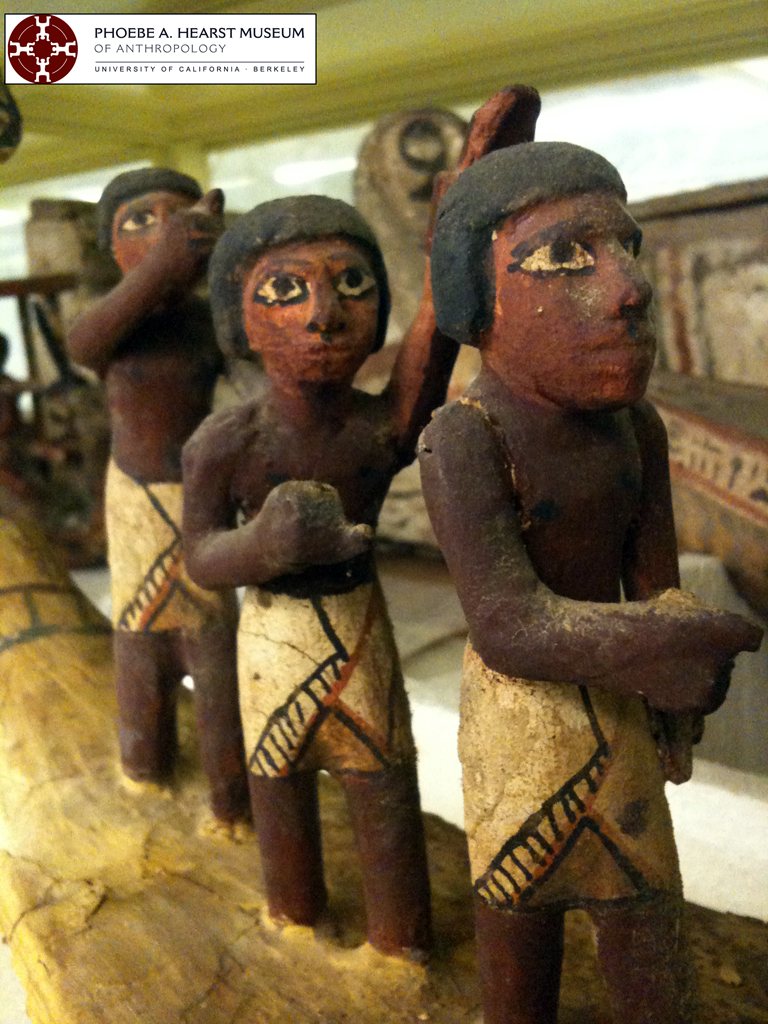
To complement the Egyptian collections acquired by George Reisner under the patronage of Phoebe Hearst, the museum accessioned a number of objects from other sources and donors throughout its history. Some of them later turned out to be modern or contemporary reproductions of archaeological pieces. In other words: fakes.
Fakes and forgeries are rather common in museum collections and PAHMA is no exception. It should be specified that in many cases fake objects were willingly accessioned despite or indeed because of their nature. Known forgeries curated in Berkeley include ancient Roman coins, Mexican figurines, Egyptian scarabs, Chinese pottery and even a shrunken "head" from Ecuador made with animal skin and hair.
In 1992, a selection of such objects was featured in a public exhibit entitled Too Good To Be True. The following text is what visitors could read almost twenty years ago on the exhibit label for today's object.
Egyptian funerary boats were traditionally used in the funerary voyages to and from the sanctuary of Osiris at Abydos. To be without a boat for this crossing meant that the spirit might be barred from immortality. This particular model was made in 1935 A.D. and purchased in Egypt by Mrs. Alma Spreckles while on a buying trip for the California Palace of the Legion of Honor in San Francisco. Model boats are now often crudely made from genuine pieces of ancient wood or, more commonly, "antiqued" by immersing the wood in camel urine, a process which greatly enhances the boat's aura and aroma.
According to the Smithsonian Institution in the last decade more than 60,000 fakes were sequestered by the Italian police before they could enter the market. Can anyone calculate how much urine would be needed?
The featured boat is ca. 62 cm long while the figures are ca. 12-15 cm tall.

Hearst Museum # 5-14112
Fakes and forgeries are rather common in museum collections and PAHMA is no exception. It should be specified that in many cases fake objects were willingly accessioned despite or indeed because of their nature. Known forgeries curated in Berkeley include ancient Roman coins, Mexican figurines, Egyptian scarabs, Chinese pottery and even a shrunken "head" from Ecuador made with animal skin and hair.
In 1992, a selection of such objects was featured in a public exhibit entitled Too Good To Be True. The following text is what visitors could read almost twenty years ago on the exhibit label for today's object.
Egyptian funerary boats were traditionally used in the funerary voyages to and from the sanctuary of Osiris at Abydos. To be without a boat for this crossing meant that the spirit might be barred from immortality. This particular model was made in 1935 A.D. and purchased in Egypt by Mrs. Alma Spreckles while on a buying trip for the California Palace of the Legion of Honor in San Francisco. Model boats are now often crudely made from genuine pieces of ancient wood or, more commonly, "antiqued" by immersing the wood in camel urine, a process which greatly enhances the boat's aura and aroma.
According to the Smithsonian Institution in the last decade more than 60,000 fakes were sequestered by the Italian police before they could enter the market. Can anyone calculate how much urine would be needed?
The featured boat is ca. 62 cm long while the figures are ca. 12-15 cm tall.
Hearst Museum # 5-14112
Funerary boat model (detail)
Egypt; unspecified (purchased in Egypt)
Collected by Alma Spreckles, 1935
July 9, 2010
Boat
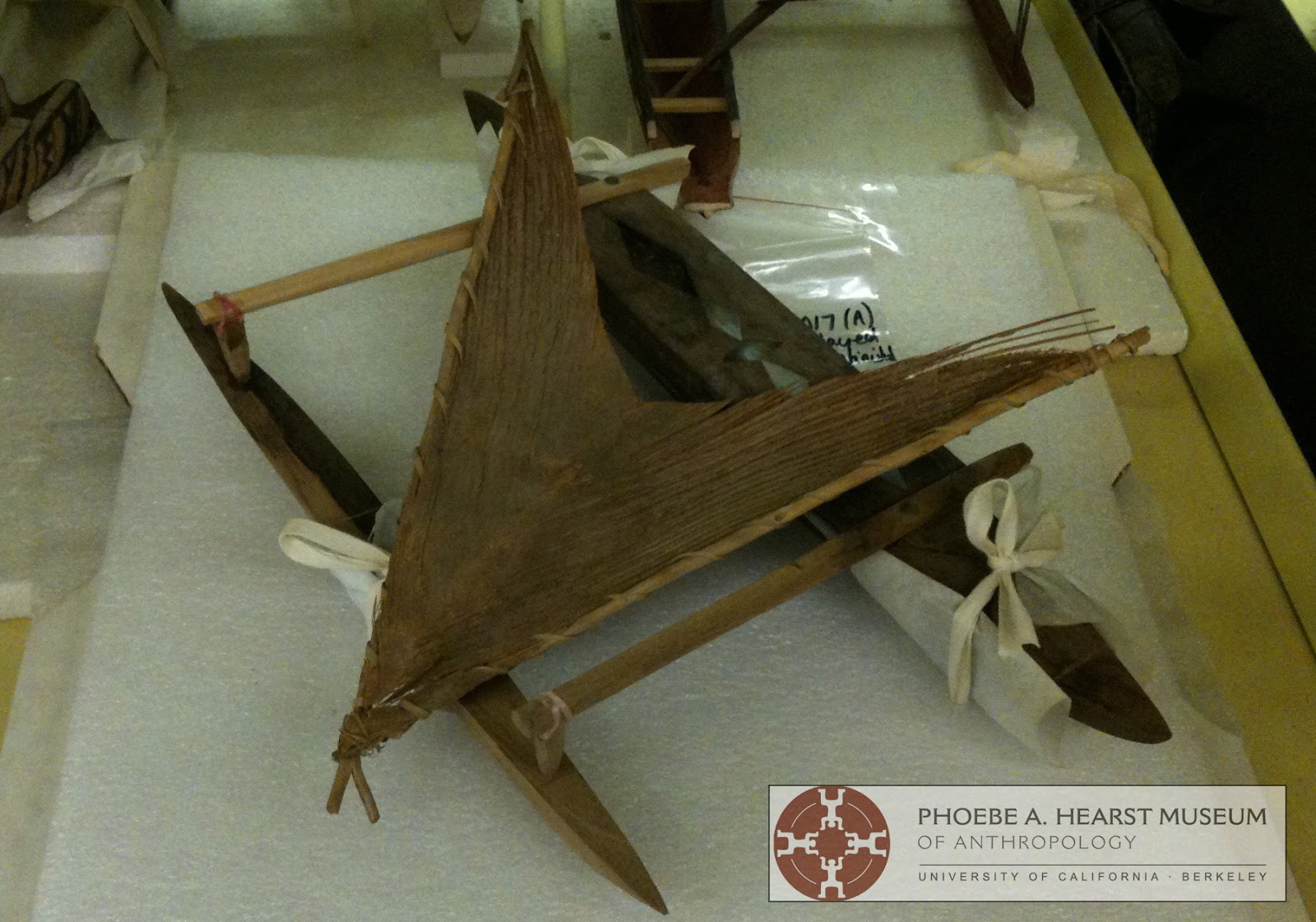
A brief diversion from the prehistoric collections and objects that are from a remote time. Few weeks ago, during a facility tour for our volunteers, I noticed this boat model from Polynesia and it made me think about places that are remote in space.
Tongareva (Penrhyn) is the most remote atoll of the Cook Islands archipelago and since I am originally from Europe, it is as remote as it gets. This model of a Polynesian outrigger was made by local school children as a learning project and sold as souvenir to the collector. Sorry for the lack of a scale: the main hull is about 40 cm long.

Hearst Museum # 11-45017a,b
Tongareva (Penrhyn) is the most remote atoll of the Cook Islands archipelago and since I am originally from Europe, it is as remote as it gets. This model of a Polynesian outrigger was made by local school children as a learning project and sold as souvenir to the collector. Sorry for the lack of a scale: the main hull is about 40 cm long.
Hearst Museum # 11-45017a,b
Boat model
Polynesia, Cook Islands, Tongareva
Collected by R. Evansizer (1952-1963)
June 25, 2010
Quartz
These quartzite tools (a core, a truncation and a geometric) were collected between 1964 and 1965 at Dindori 3, a site along the banks of the Narmada River, India. The tools are included in a sizable collection of paleolithic implements from about 30 discrete localities in the Narmada Valley in India. The archaeological expedition was organized by Theodore D. McCown and one of his students, George V. Shkurkin. Sadly it would be McCown's last field season as he passed away in 1969 after more than 30 years at UC Berkeley, first as a student and later as faculty and museum curator. The collections were then accessioned to the PAHMA and used by prof. J. Desmond Clark (and others) for teaching and research. Professor Clark went himself on archaeological expeditions in India in the 1980's.
Another prominent UC Berkeley anthropologist, Sherwood Washburn, recalled how McCown was convinced that the testing ground to understand human evolution laid to the east. The land between Palestine, where his father worked as biblical archaeologist, and India was where he thought Dryopithecines had space and time to develop the variations that eventually led to modern apes and humans.
Below is what McCown wrote to campus administrators prior to his leave of absence from the university:
The purpose of my sabbatic leave is to spend from October 1964 to May 1965 in India, investigating and excavating Pleistocene localities containing assemblages of paleolithic tools and/or fossil fauna materials. The principal localities to be tested lie in the central and eastern parts of the state of Madhya Pradesh between the town of Hosangabad and Jubbulpore. The area is one I visited and surveyed during five weeks in the spring and summer of 1958 on sabbatic leave from the University. A number of promising localities were visited, but it became obvious that the main stream of the Narmada River poses problems whose solutions will have to be sought along the tributary systems running it from Vindhya mountains to the north and the Satpuras to the south. No systematic investigation has been made of the remnants of the terrace system, especially where they have been dissected by the Narmada's tributaries.
Hearst Museum #9-10093; 9-10074; 9-10072
Another prominent UC Berkeley anthropologist, Sherwood Washburn, recalled how McCown was convinced that the testing ground to understand human evolution laid to the east. The land between Palestine, where his father worked as biblical archaeologist, and India was where he thought Dryopithecines had space and time to develop the variations that eventually led to modern apes and humans.
Below is what McCown wrote to campus administrators prior to his leave of absence from the university:
The purpose of my sabbatic leave is to spend from October 1964 to May 1965 in India, investigating and excavating Pleistocene localities containing assemblages of paleolithic tools and/or fossil fauna materials. The principal localities to be tested lie in the central and eastern parts of the state of Madhya Pradesh between the town of Hosangabad and Jubbulpore. The area is one I visited and surveyed during five weeks in the spring and summer of 1958 on sabbatic leave from the University. A number of promising localities were visited, but it became obvious that the main stream of the Narmada River poses problems whose solutions will have to be sought along the tributary systems running it from Vindhya mountains to the north and the Satpuras to the south. No systematic investigation has been made of the remnants of the terrace system, especially where they have been dissected by the Narmada's tributaries.
Hearst Museum #9-10093; 9-10074; 9-10072
India; Madhya Pradesh; Narmada valley; Dindori 3
Collected by Theodore D. McCown and George V. Shkurkin, 1964-1965
Subscribe to:
Comments (Atom)