Image

Image

July 26, 2010

Fake boat

To complement the Egyptian collections acquired by George Reisner under the patronage of Phoebe Hearst, the museum accessioned a number of objects from other sources and donors throughout its history. Some of them later turned out to be modern or contemporary reproductions of archaeological pieces. In other words: fakes.
Fakes and forgeries are rather common in museum collections and PAHMA is no exception. It should be specified that in many cases fake objects were willingly accessioned despite or indeed because of their nature. Known forgeries curated in Berkeley include ancient Roman coins, Mexican figurines, Egyptian scarabs, Chinese pottery and even a shrunken "head" from Ecuador made with animal skin and hair.
In 1992, a selection of such objects was featured in a public exhibit entitled Too Good To Be True. The following text is what visitors could read almost twenty years ago on the exhibit label for today's object.

Egyptian funerary boats were traditionally used in the funerary voyages to and from the sanctuary of Osiris at Abydos. To be without a boat for this crossing meant that the spirit might be barred from immortality. This particular model was made in 1935 A.D. and purchased in Egypt by Mrs. Alma Spreckles while on a buying trip for the California Palace of the Legion of Honor in San Francisco. Model boats are now often crudely made from genuine pieces of ancient wood or, more commonly, "antiqued" by immersing the wood in camel urine, a process which greatly enhances the boat's aura and aroma.

According to the Smithsonian Institution in the last decade more than 60,000 fakes were sequestered by the Italian police before they could enter the market. Can anyone calculate how much urine would be needed?
The featured boat is ca. 62 cm long while the figures are ca. 12-15 cm tall.
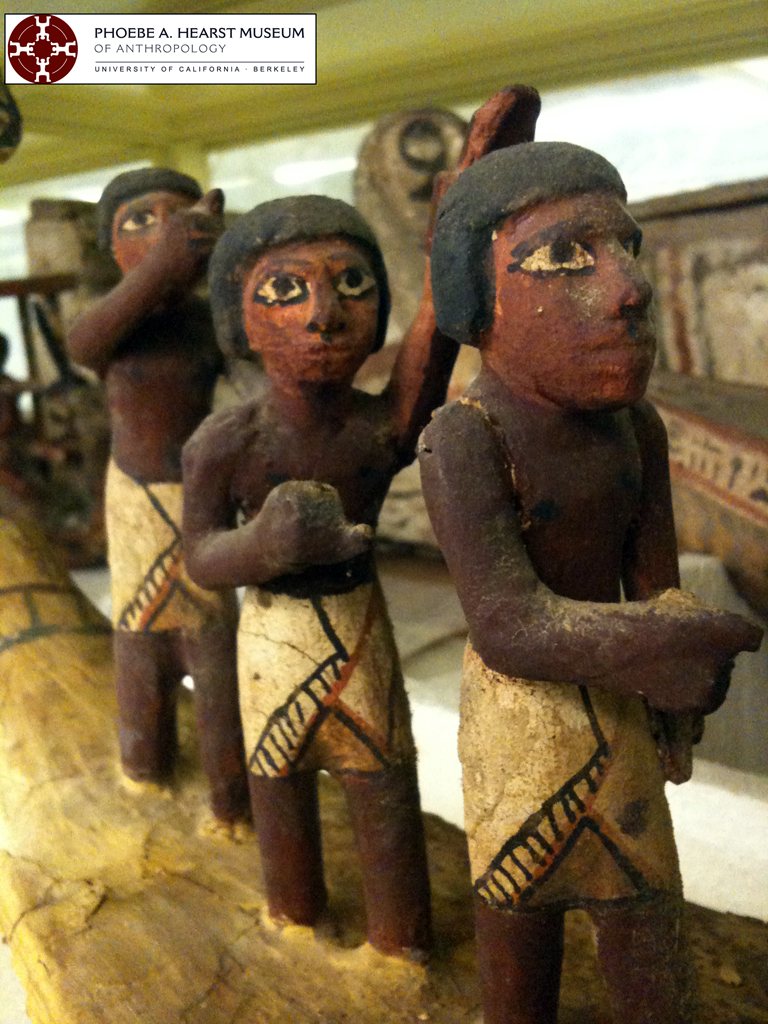


Hearst Museum # 5-14112
Funerary boat model (detail)
Egypt; unspecified (purchased in Egypt)
Collected by Alma Spreckles, 1935

July 9, 2010

Boat

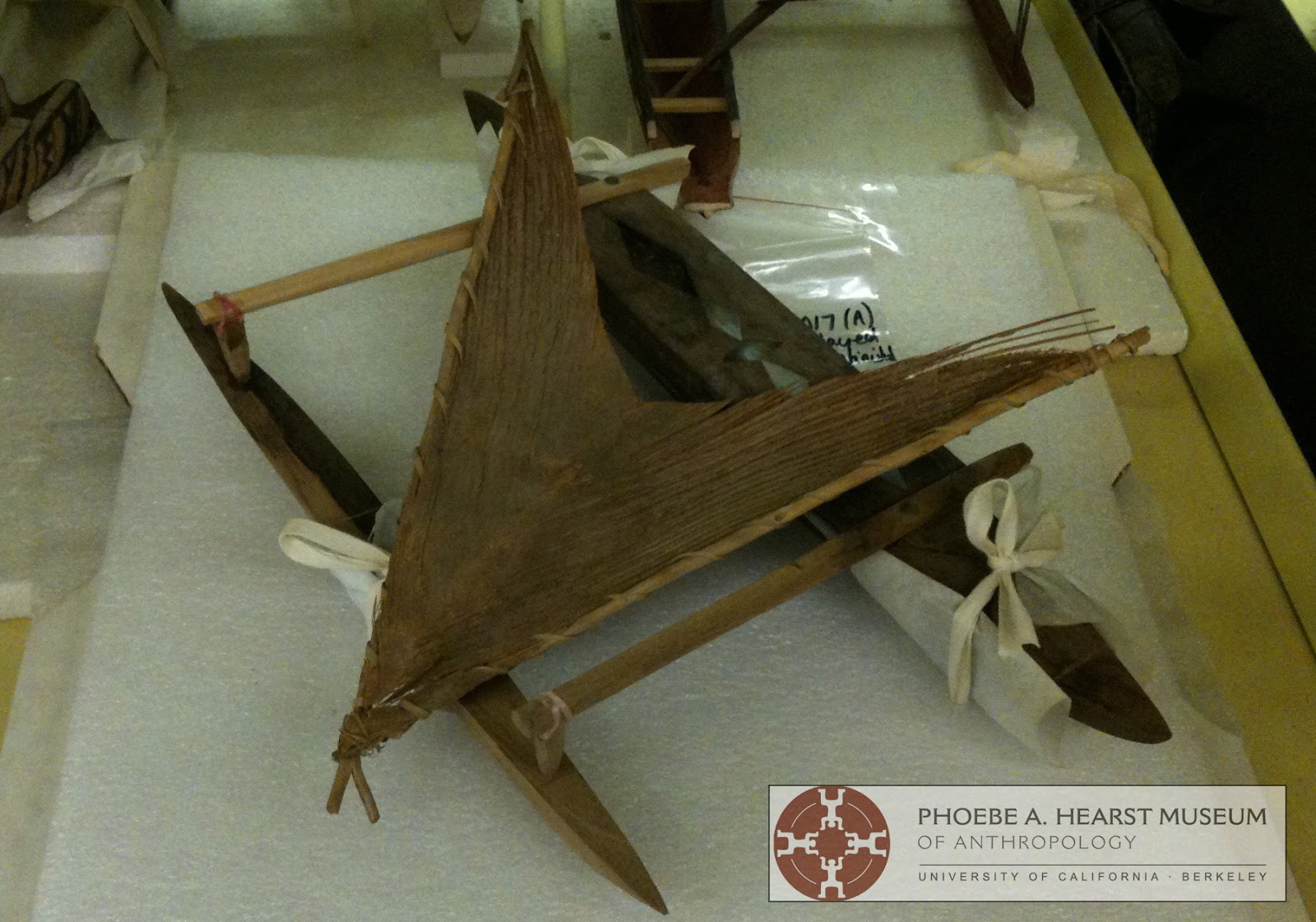
A brief diversion from the prehistoric collections and objects that are from a remote time. Few weeks ago, during a facility tour for our volunteers, I noticed this boat model from Polynesia and it made me think about places that are remote in space.
Tongareva (Penrhyn) is the most remote atoll of the Cook Islands archipelago and since I am originally from Europe, it is as remote as it gets. This model of a Polynesian outrigger was made by local school children as a learning project and sold as souvenir to the collector. Sorry for the lack of a scale: the main hull is about 40 cm long.


Hearst Museum # 11-45017a,b
Boat model
Polynesia, Cook Islands, Tongareva
Collected by R. Evansizer (1952-1963)

June 25, 2010

Quartz

These quartzite tools (a core, a truncation and a geometric) were collected between 1964 and 1965 at Dindori 3, a site along the banks of the Narmada River, India. The tools are included in a sizable collection of paleolithic implements from about 30 discrete localities in the Narmada Valley in India. The archaeological expedition was organized by Theodore D. McCown and one of his students, George V. Shkurkin. Sadly it would be McCown's last field season as he passed away in 1969 after more than 30 years at UC Berkeley, first as a student and later as faculty and museum curator. The collections were then accessioned to the PAHMA and used by prof. J. Desmond Clark (and others) for teaching and research. Professor Clark went himself on archaeological expeditions in India in the 1980's.
Another prominent UC Berkeley anthropologist, Sherwood Washburn, recalled how McCown was convinced that the testing ground to understand human evolution laid to the east. The land between Palestine, where his father worked as biblical archaeologist, and India was where he thought Dryopithecines had space and time to develop the variations that eventually led to modern apes and humans.
Below is what McCown wrote to campus administrators prior to his leave of absence from the university: 
The purpose of my sabbatic leave is to spend from October 1964 to May 1965 in India, investigating and excavating Pleistocene localities containing assemblages of paleolithic tools and/or fossil fauna materials. The principal localities to be tested lie in the central and eastern parts of the state of Madhya Pradesh between the town of Hosangabad and Jubbulpore. The area is one I visited and surveyed during five weeks in the spring and summer of 1958 on sabbatic leave from the University. A number of promising localities were visited, but it became obvious that the main stream of the Narmada River poses problems whose solutions will have to be sought along the tributary systems running it from Vindhya mountains to the north and the Satpuras to the south. No systematic investigation has been made of the remnants of the terrace system, especially where they have been dissected by the Narmada's tributaries.


Hearst Museum #9-10093; 9-10074; 9-10072
India; Madhya Pradesh; Narmada valley; Dindori 3
Collected by Theodore D. McCown and George V. Shkurkin, 1964-1965

June 24, 2010

Figurines

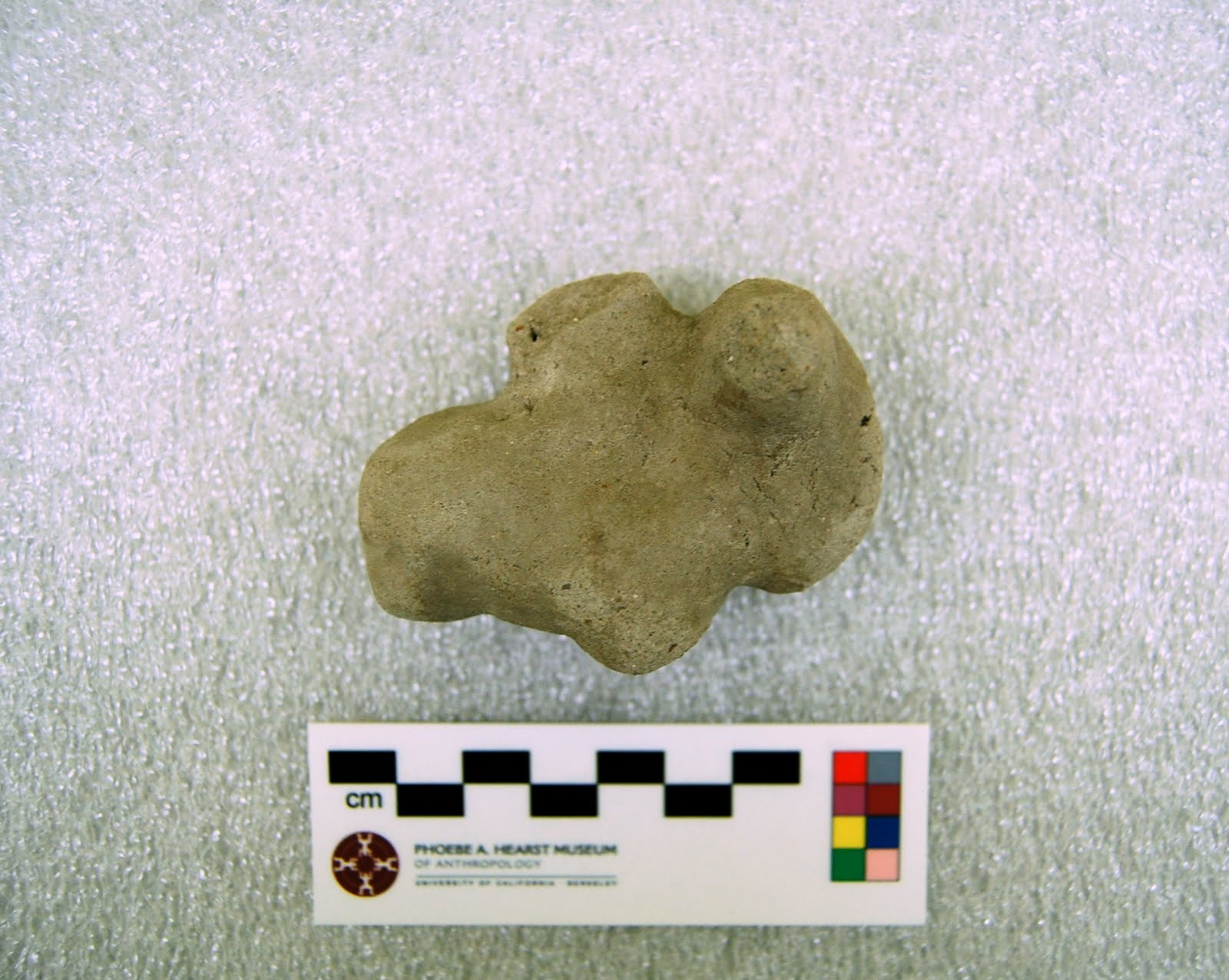
These clay figurines are from Karkarinchinkat Nord, a neolithic site in the Tilemsi Valley, Republic of Mali. They were excavated in 1972 by Dr. Andrew Smith as part of his doctoral dissertation. A radiocarbon date of the stratigraphic horizon indicated that they were buried between 2000 and 1360 B.C.
Simple, small figurines similar to these are commonly found among the remains of early agro-pastoral villages in Africa, Europe and the Near East. I excavated two myself (here's an example) while working at the neolithic tell of Çatalhöyük, Turkey, a few years back. Together with the simplicity of their human shape, a common feature is the large, flat bottom, which likely served the purpose of having them sitting on small chairs or stools. Elaborate, finely crafted sets of figurines were found in Neolithic villages in Southeastern Europe (e.g., from Cucuteni, Romania) and their significance and use within a particular household or the entire community have been variously interpreted. The figurines from Karkarinchinkat, even accounting for their considerable age, seem to have been fashioned in a rather expedient way without a great attention to details. Not far from where the figurines were excavated laid the burial of a young child. Although the two archaeological features were not considered associated, it is still possible to imagine that these figurines could be child toys.

The numerous toys and game pieces that are housed at the PAHMA, both archaeological and ethnographic, were made using various materials; stone, grasses, ivory, bones and wood. Below the figurines are two objects from the African collection, all of them made with clay.


Hearst Museum # 5-11898
Figurines
Mali; Tilemsi Valley; Karkarinchinkat Nord
Collected by Andrew Smith, 1972


Hearst Museum # 5-13623
Clay figurine, hump-backed (Zebu) cow; modern ethnographic; child’s toy.
Africa; Malawi
Collected and donated by J. Desmond Clark, 1965


Hearst Museum # 5-10656
Fired clay cylinders; roulette decoration on surface (gaming pieces?)
Africa; Mali; Tin Aberz
Collected by J. Desmond Clark, 1972

June 2, 2010

Points

One of the largest accession of Old World archaeology at the PAHMA includes the assemblages collected during the University of California African Expeditions in 1947 and 1948. The availability of these collections for teaching and scholarly research raised an interest that, within few years, contributed to turn the Berkeley campus as one of the world's most active center for African prehistory.

As customary for museum collections devoted to teaching, assemblages were sometimes broken down in smaller sets that represent specific periods or technological phases. Over the years, students and researchers left notes and comments - most often than not on scrap pieces of paper - about the items they were studying. One note was found at the bottom of a small box containing these three objects from a locality near the Taungs Limeworks, Republic of South Africa. The author signed the comment though the signature is unfortunately hard to read making it impossible to date it with certainty. In my personal opinion it could be from the early 1950's. Here is the note's transcription:

The larger specimen (brown) is an excellent evolved Middle Stone Age point with reduction of the bulb of percussion on the cleavage face. Such points occur in developed phases of the M.S.A. but are never common. The dark chert point is also evolved M.S.A. The curvature is probably merely fortuitous. The white quartz specimen is not significant.


Hearst Museum 5-8902
Middle Stone Age Points
Republic of South Africa; Cape Province; Taungs Limeworks
Collected by Charles L. Camp and Frank E. Peabody, 1947-1949


Hearst Museum 5-8901
Quartz crystal
Republic of South Africa; Cape Province; Taungs Limeworks
Collected by Charles L. Camp and Frank E. Peabody, 1947-1949

May 1, 2010

Blade core

This obsidian core was collected by Robert F. Heizer during one of his archaeological expeditions in Guatemala. Unlike jade, which was circulating primarily among the upper classes of central American societies, obsidian was readily available to most households. Cores and blades were produced and traded in large numbers to be used, with appropriate modifications, in hunting, farming, woodworking, weaponry and  ritual. In a 1971 volume, Heizer and colleagues published an account of blade production among the Atzecs as told by the Spanish missionary Motolinia, soon after the Spanish conquest.

Robert F. Heizer came to UC Berkeley in the 1930s as an undergraduate transfer from Sacramento Junior College, then an active center for archaeological research in northern California. He received his BA (1936) and PHD (1941) working closely with Alfred Kroeber and, soon after World War II, he was appointed Assistant Professor (1946) in the Anthropology Department. He was Curator of North America Archaeology at the PAHMA from 1956 until his death in 1979.

One of the first to realize that archaeological research in pre-war California was rather crude in its field methods and general modus operandi, Heizer was always a strenuous proponent of rigorous methodology and a pioneer of scientific applications. It is thus perhaps surprising that early in his career his attention to detail was apparently a matter of concern, as expressed in this hand-written note archived at the museum. The author of the note was Llewellyn Lemont Loud who had worked for the museum since 1911 and spent years excavating and recording archaeological sites in California and Nevada.

More than 60 years later, the remarks feel more like rivalry between different institutions than personal grudge or criticism. Loud himself was a cause for frustration for Alfred Kroeber who, at times, questioned Loud's commitment to wrapping up his archaeological reports in a timely manner. It took Loud 17 years to complete the publication of his excavation at Lovelock cave, Nevada (1912-1929).


Hearst Museum 3-22955
Obsidian prismatic blade core
Guatemala, Papalhuapa, "Templo de Montezuma"
Collected by Robert F. Heizer, John Graham and H. Williams, 1965

April 10, 2010

Core

After serving as curator and director of the National Museum of Zambia (1938-1961), J. Desmond Clark came to UC Berkeley in 1961 and for almost thirty years he trained students in anthropology and Old World prehistory.

Prof. Clark was instrumental for increasing the size and scientific value of the Old World prehistoric collections at the PAHMA with assemblages from his research in Africa and Asia and by promoting active programs of exchange with museums in Africa and Europe intended to complement the preexisting collections.

The museum houses assemblages from a few archaeological sites excavated by his students mainly in the early 1970's. Some of these collections were never fully studied and published by their original investigators. This quartzite core is part of a sizable assemblage from an excavation in the Democratic Republic of the Congo between 1971 and 1973. The stone tools were deposited at the museum a few years later with little information as to their provenience, collection methods or field notes. J. Desmond Clark recalls this project in his memoirs*: 

Various sites in the Congo or Rwanda have a longish sequence from the late Acheulean through the Middle Stone Age. One site in the Katanga Province, in Zaire, it was dug by a delightful old French priest, Pere Anciaux de Faveaux, who had found this site and reported on it in the Third Pan-African Congress [...]. He found a very nice Acheulean site at the Pupa River near Katentania on the Biano River, and a student of mine, Carney Schokkenbroek [...] did a very nice excavation of the Acheulean and overlying Lupenbaum following on from what Anciaux did, and she was out there for probably two years, I think, working on those collections, doing the excavation, et cetera, with Anciaux. But she never wrote it up. We were hoping she would write it up, but she seems to have disappeared now.

Perhaps she had disappeared but the stone tools are still in Berkeley.


Hearst Museum # uncatalogued
Core
Dem. Rep. of the Congo; Katanga Prov.; Pupa River near Katentania
Collected by Carney Schokkenbroek, 1973

* J. Desmond Clark, "An Archaeologist at Work in African Prehistory and Early Human Studies: Teamwork and Insight," an oral history conducted in 2000-2001 by Timothy Troy, Regional Oral History Office, The Bancroft Library, University of California, Berkeley, 2002.

April 5, 2010

Neanderthal flint

Dorothy A.E. Garrod was the first woman (1939) to be elected Professor of Archaeology at Cambridge. Her career started in the early 1920's and brought her from Gibraltar, to the east Mediterranean, to Kurdistan. 

Arguably, her most important achievement in the field is the excavation at Mount Carmel where, among thousands of stone tools, she recovered the first Neanderthal burials outside Europe. During the 1931 season Garrod was assisted by Theodore D. McCown, a PhD student at UC Berkeley, who later served as a curator for the museum between 1947 and 1957.

The excavation of the Mt. Carmel caves lasted a few years and the results were published in a large volume in 1939. As was customary for those times, the lithic collections were then split among numerous institutions around the world. Here is a list of all the places one should travel if interested in these assemblages.

Through the study of the skeletal remains and animal bones, Garrod and McCown offered early reconstructions of the changes in the environment from the Middle Paleolithic to the early Neolithic in the Near East.  Reporting on their findings in 1934, The Pittsburgh Press points out that the region was home to the Neanderthals from the early Mousterian until their final demise. The short article doesn't provide any details as to how or why the brutes went eventually extinct but it offers an interesting choice of words to describe their character while they were alive and roaming around: Neanderthals were uncouth and clumsy
Think twice before inviting a Neanderthal to a formal dinner: they will probably show up unshaved, half naked, and they will leave all their food scraps on your floor.

Hearst Museum # 9-1286
Acheuleo-Mousterian flint
Palestine; Mt. Carmel region; Tabun Cave; Wady el-Mughara
Collected by Dorothy A.E. Garrod, 1932-1933

April 1, 2010

Frog

For the last few months the Hearst Museum of Anthropology has been in the process of moving a substantial portion of the collections out of one storage area that was recently sold by the University. One of the last pieces we moved was a 39.1ft. (11.9 m.) totem pole from British Columbia. The totem was originally erected around 1870 for a Haida man named Haostis and his wife K'awa; it was brought to the museum in 1911. During the moving process the totem was temporarily unwrapped and almost fully visible for the first time in 36 years; since it was removed from the museum's patio in 1974.

Totem poles served the purpose of illustrating particular events in the history of the owner's family and its rights over the land. They were also erected to commemorate deceased members of the family or household. What follows is what a Tlingit elder told the museum curators in 1964:
"This is a Grizzly bear pole. Head with Raven coming out of mouth refers to a story of a man who told a lie for gain. Putting the leg or foot of upper figure in ears of major heads is a Haida idea. Man at bottom in bears' grasp is a deceased relative; hat indicates social status. Bird at top of pole is a Raven"

Almost all totem poles display the crests of one or more families connected with the owner. This particular specimen has a grizzly bear (for Haostis) and a frog (for K'awa).

Frogs are ubiquitous in the art from the Northwest Coast though, at the time the totem was carved, they appeared to be a quite uncommon figure of the Queen Charlotte Islands landscape. The Haida have an explanation for this phenomenon that it is not what a biology journal would publish but it is a much better story to read to kids before they go to bed. James Deans recorded the story in 1870.


Hearst Museum #2-10723
Totem pole (detail)
British Columbia; east coast of Queen Charlotte Is.
Collected by C.F. Newcombe, 1910

March 5, 2010

Knife

This flint knife was donated to the museum by Heywood W. Seton-Karr, a British Army lieutenant who made his earlier archaeological discoveries while he was stationed in Egypt and, later, as a private consultant. In 1895 he presented his finds to the British Anthropological Institute and in1898 his enterprises were featured in the New York Times.

Not a trained archaeologist, Mr. Seton-Karr benefited from having access to Sir. John Evans type collection of Paleolithic implements. His first sizable collections thus included mostly Paleolithic hand axes that he recovered during his hunting trips in East Africa.
In a letter to the President of the University of California dated to 1925, he listed “twenty-nine expeditions to India, thirteen in Somaliland, nine in the Fayum region, and several in the Eastern and Western Deserts of Egypt”. Mr. Seton-Karr donated portions of his collection to a large number of museums around the world. The stone tools in storage at the PAHMA came via the Smithsonian Institution and the Peabody Museum.

In 1905 he published his findings in the Fayum region in a book of  drawings whose reviewer in the MAN journal praised for its usefulness for researcher but also complained that it was hard to obtain a copy.

Mr. Heywood Seton-Karr last donation came to the museum in 1931 but because the donor demanded that the specimen would be on permanent exhibit it was initially rejected. Once he agreed to remove the condition the gift was accepted.
A selection of his stone tools from Egypt and Somalia was exhibited for the first time in Berkeley in the Fall of 1940.


Hearst Museum # 5-557
Flint knife
Fayum, Egypt
Collected and donated by H.W. Seton-Karr